

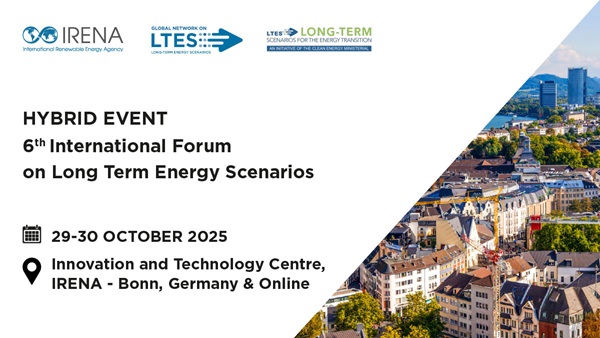
6th International Forum on Long-term Energy Scenarios for the Clean Energy Transition
Initiated in 2018, IRENA’s Global Network of Long-Term Energy Scenarios (Global LTES Network) and Clean Energy Ministerial (CEM) Initiative on LTES provides a global platform to exchange knowledge and good practices in the use and development of scenarios to guide the clean energy transition and promote wider and more effective use of LTES in government for energy and climate policymaking.
At the 6th edition of its annual flagship International Forum on Long-term Scenarios for the Clean Energy Transition, IRENA brought together scenario practitioners in government, academia, technical institutions, international organizations, and the private sector. The 6th Forum focused on the following Global Network on LTES Thematic Areas outlined in the May 2025- April 2026 Workplan:
- Institutional Coordination and Alignment: Integrating LTES frameworks with national strategies like climate plans, grid expansion, and socio-economic policies for coherent policy implementation.
- Investment Mobilization: Translating scenarios into actionable pipelines, de-risking projects, and engaging financial institutions to bridge planning-implementation gaps.
- Scenario Tools, Communication, and Stakeholder Engagement: Adopting open-source tools, transparent communication, and participatory processes to build trust, inclusivity, and in-house capacity.
- Resilient and Inclusive Scenario Content: Incorporating energy security, demand-side shifts (e.g., AI), and just transition elements to model robust, equitable pathways amid uncertainties.
The Forum took place at the IRENA Innovation and Technology Centre in Bonn, Germany, on Wednesday 29th and Thursday 30th October 2025 in a hybrid format (on-site and virtual).
Click here to view the programme overview:
Please reach out to us at LTES@irena.org if you have any questions.
Agenda
| Central European Time (CET) | Event |
|---|---|
| 8:00 – 9:00 |
Badge Collection and Coffee |
| 9:00 – 9:45 |
Opening Session This session established a common framing of current challenges to public and political support for the transition and confirm cross-cutting priorities that will guide the Forum. Welcome remarks:
Scene-setting presentation and forum logistics: Juan Jose Garcia, Programme Officer, IRENA Presentation slides can be accessed here: IRENA Scene Setting |
| 9:45 – 11:15 |
Session 1: Long-term energy scenarios frameworks and NDC alignment in practice: coordination, decision cycles and national budget integration Delivering on national climate commitments requires close coordination between energy planning and climate policy processes. This session explored how countries are using LTES frameworks to align with NDC/LT-LEDS in practice, focusing on real challenges faced by planning teams (roles across Finance–Energy–Environment, decision-making cycles/budget hooks, and near-term security/resilience needs). Introduction: Simon Benmarraze, Head Energy Transition Planning and Power Sector Transformation, IRENA Short presentations:
Country presentation: Spain and Guatemala Presentation slides can be accessed here: IRENA Scene Setting | Carlos Ruiz Sanchez | Aurora Recio Gonzalez | Gabriel Armando Velasquez |
| 11:15 – 11:45 |
Coffee Break |
| 11:45 – 13:15 |
Session 2: Grid planning to bankable grid pipelines: risk allocation and policy signals from scenarios This session explored how policy signals from LTES-based grid planning – such as prioritized transmission corridors and substations, locational development signals, and indicative CAPEX envelopes – translated into investor-relevant risk-allocation options for transmission and distribution projects. Speakers identified the risks that most limit private capital in current pipelines and the risk-allocation option under consideration to address them.
Moderator: Simon Benmarraze, Head Energy Transition Planning and Power Sector Transformation, IRENA Scene-setting presentations:
Presentation slides can be accessed here: IRENA Scene Setting | Lucas de Oliveira |
| 13:15 – 14:15 |
Lunch |
| 14:15 – 15:45 |
Session 3: Communicating scenarios to build strong public and political support for the energy transition This session explored how scenario insights can be communicated in ways that strengthen public confidence, highlight economic and social opportunities, and reinforce the reliability of clean energy systems. Panelists shared experiences turning LTES results into messages that resonate with citizens, policymakers, and opinion-shapers, and that link the transition to tangible benefits such as affordable energy, quality jobs, and improved security. The discussion presented IRENA’s participatory planning toolkit as a resource for engaging stakeholders and shaping inclusive narratives that inspire action. Introduction: Nadeem Goussous, Associate Programme Officer, IRENA
Scene-setting presentations:
Presentation slides can be accessed here: IRENA Introduction Presentation | Franziska Bock | Evangelos Panos | Johanna Stella Castellanos Arias |
| 15:45 – 16:15 |
Coffee Break |
| 16:15 – 17:45 |
Session 4: Empowering institutional planning ownership through selection of tools This session explored how countries have institutionalized open-source and other modelling tools within their planning systems, overcoming challenges such as staff turnover, funding gaps, and long deployment timelines. Panelists shared governance approaches that retain skills, enable rapid operationalization, and integrate models into permanent institutional processes. The emphasis was on how open-source tools can be embedded into national planning ecosystems for resilience, transparency, and agility – not on technical training. Moderator: Christopher Gross, Team Lead, GET.transform
Scene-setting presentations:
Presentation slides can be accessed here: Maike Groninger | Larissa Pinheiro Pupo Nogueira | Natalia Alvarado Sanabria |
| 18:00 – 21:00 |
Welcome Dinner |
| Central European Time (CET) | Event |
|---|---|
| 8:00 – 9:30 |
Coffee and Networking |
| 8:15 – 9:30 |
Closed-door session: LTES Network Members and Partners strategic meeting |
| 9:30 – 11:00 |
Session 5: Addressing Supply Chains in Energy Scenarios Global supply chains for critical materials and technologies, such as batteries, solar modules, and electrolyzers, are increasingly exposed to geopolitical risk, trade disputes, and concentrated market power. This session explored how scenario-based planning can be used to stress-test supply chain assumptions and examine strategic options for resilience, including diversification of suppliers, regional manufacturing, and strategic reserves. Drawing on national and regional experiences, panelists showed how LTES-informed analysis has supported industrial policy, investment prioritization, and regional cooperation strategies to reduce vulnerability. The focus was on translating supply chain risk insights into policy pathways and strategic choices that strengthen resilience.
Moderator and Scene Setting: Nicola Magnani, European Commission Joint Research Centre (JRC)
Presentation slides can be accessed here: IRENA Opening Presentation | Nicola Magnani | Matias Paredes | Tord Bjørndal | James Glynn |
| 11:00 – 11:30 |
Coffee Break |
| 11:30 – 13:00 |
Session 6: Addressing the future of digitalization through demand-side planning The rapid growth of data centers, AI computing hubs, and other digitally driven loads is reshaping long-term electricity demand trajectories. While these loads can emerge quickly, their potential scale and location patterns can be anticipated and integrated into national LTES to guide infrastructure investment, location priorities, and policy design well in advance. This session explored how countries are incorporating digitalization signals — such as sector growth forecasts, industrial zoning trends, and technology adoption pathways — into demand-side scenario frameworks. The focus was on using LTES to prepare the power system for sustained demand growth from digitalization, enabling timely investment in grids, flexibility resources, and supporting infrastructure.
Moderator Tiina Koljonen, Principal scientist, VTT Technical Research Centre, Finland
Scene-Setting Presentations:
Country presentations: Colombia, Korea, Portugal
Presentation slides can be accessed here: Adrian Gonzalez | Ricardo Aguiar | Seoungho Lee | Johanna Stella Castellanos Arias |
| 13:00 – 14:00 |
Lunch |
| 14:00 – 15:15 |
Session 7: Governing AI in energy planning: Lessons from early deployments Artificial intelligence is already being piloted and deployed in energy planning across diverse contexts, from grid forecasting to transmission investment planning, demand forecasting, and asset risk screening. This session focused on the governance structures that enabled these solutions to be used in planning processes. Panelists shared experiences on issues such as institutional mandates, cross-ministerial coordination, public–private partnerships, procurement and data governance, validation and explainability requirements, and capacity-building for in-house adoption. The aim was to distill practical governance models that countries can adapt to integrate AI responsibly into scenario design, grid planning, and infrastructure investment decision-making.
Moderator: Juan Jose Garcia, Programme Officer, IRENA
Opening Remarks: Nawal Alhanaee, Director of Future Energy department, Ministry of Energy and Infrastructure, UAE
Scene-Setting Presentations: Gianluca Lipari, Technical Leader - European Projects Coordinator, EPRI Europe DAC
Presentation slides can be accessed here: Gianluca Lipari | Evangelos Panos | Mark Howells |
| 15:15 – 15:45 |
Coffee Break |
| 15:45 – 16:45 |
Session 8: Just transition and employment impacts in energy scenarios This session explored how LTES approaches can support nationally defined just transition pathways that address socioeconomic, workforce, and social protection dimensions. These themes reflect the holistic framing of the UAE Just Transition Work Programme — an UNFCCC-mandated process whose fourth dialogue will take place in September at Africa Climate Week. Panelists discussed how scenario processes can anticipate labor market and regional economic impacts, quantify fiscal needs, and design policy measures that maintain support across political cycles. The focus was on governance and planning practices that embed equity and inclusion in transition pathways, ensure sustainable financing, and build coalitions between government, industry, labor, and communities.
Moderator: Reshma Francy, Associate Director, Policy Pathfinding and Trilemma, World Energy Council
Scene-Setting Presentations:
Presentation slides can be accessed here: Mirjam Reiner | Arnaldo dos Santos Junior |
| 16:45 – 17:00 |
Closing Remarks |
This event builds on the rich discussions held through IRENA’s Global LTES Network. Information on previous iterations of the Forum and other events can be found below: